IGNOU Project Objectives: How to Write Clear and Effective Objectives
Preparing an IGNOU project synopsis requires careful planning and a clear understanding of your research topic. One of the most important sections of a synopsis is the project objectives. These statements explain what your research intends to study, examine, or achieve.
Whether you are preparing an MBA, MAPC, BTS, or another IGNOU project, well-written objectives help give your research a clear direction. This guide explains how to write effective IGNOU project objectives, provides examples, and highlights common mistakes to avoid.
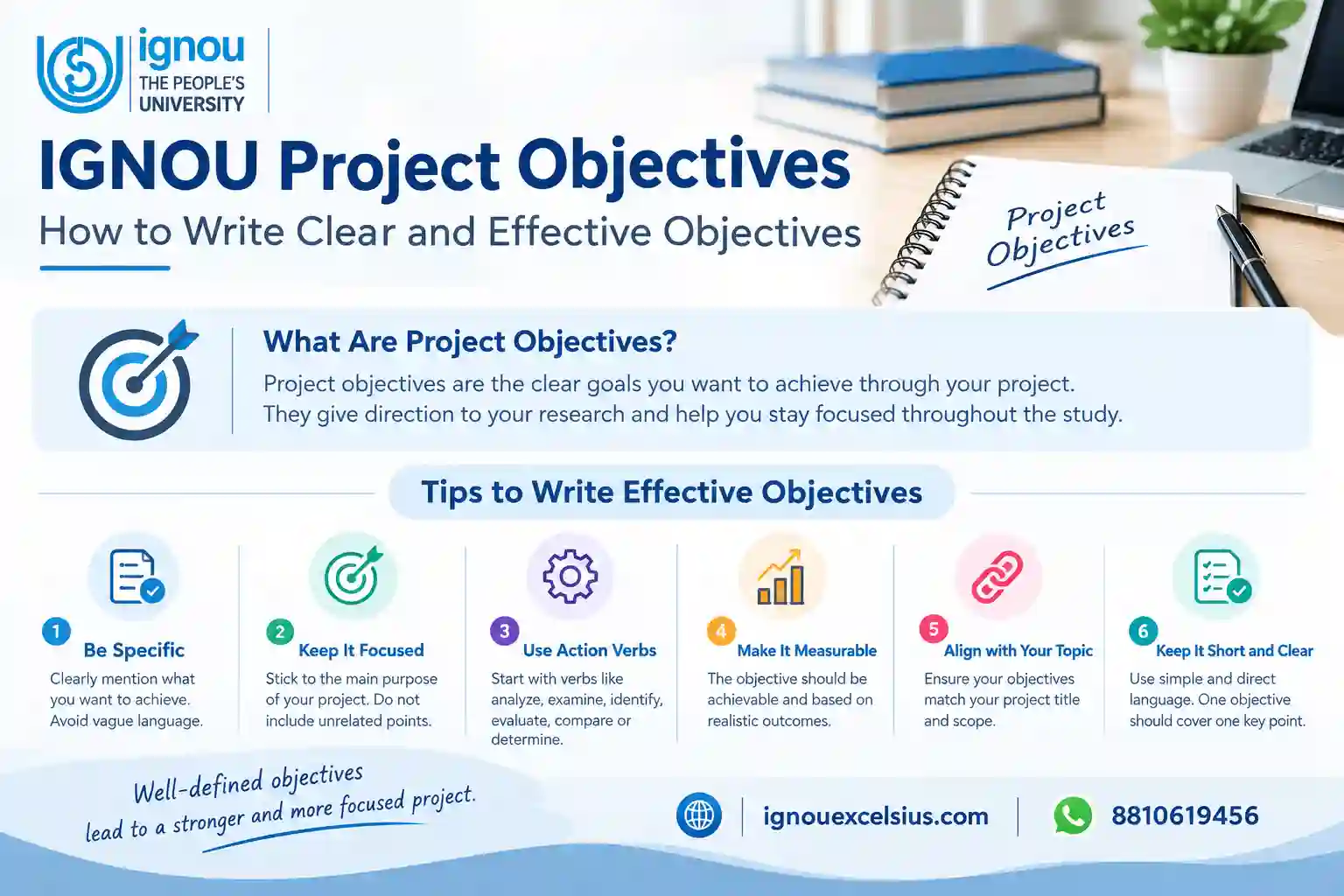
What Are IGNOU Project Objectives?
IGNOU project objectives are statements that describe the purpose of your research. They explain what you want to investigate, understand, compare, or evaluate through your project.
For example, if your project topic is “A Study of Customer Satisfaction in Online Shopping,” your objectives may focus on customer preferences, satisfaction levels, and factors affecting the online shopping experience.
Your objectives should be connected to your project title and research problem. They should clearly explain the intended scope of your study.
If you are preparing your synopsis, you can also read our guide on how to write an IGNOU synopsis for information about the other important sections.
Why Are Project Objectives Important?
Project objectives help you organise your research and maintain focus throughout the project. They are important because they:
- Explain the purpose of your research.
- Help you identify the information you need to collect.
- Guide your choice of research methods.
- Keep your project focused on the selected topic.
- Help your project guide understand your intended study.
- Provide a basis for presenting your research findings.
Your research questions, data collection methods, analysis, and conclusions should relate to the objectives you have written.
How to Write IGNOU Project Objectives
1. Understand Your Project Topic
Before writing your objectives, read your project title carefully. Identify the main subject, research problem, and area you want to study.
For example, a project on employee motivation should focus on workplace motivation, employee experiences, or factors affecting job satisfaction.
A clear understanding of your topic will help you write relevant and focused objectives.
2. Identify the Main Purpose of Your Research
Ask yourself what you want to find out through your project. Your answer should form the central purpose of the study.
For example:
“To study the factors influencing employee motivation in private organisations.”
This statement gives your research a clear direction and identifies the main subject of investigation.
3. Use Clear and Action-Oriented Words
Start your objectives with precise research verbs. Some useful examples include:
- To study
- To examine
- To analyse
- To identify
- To assess
- To compare
- To evaluate
- To understand
Avoid vague phrases such as “to know everything about” or “to provide complete information.” These expressions do not clearly explain what your research will investigate.
4. Keep Your Objectives Specific
Each objective should focus on one meaningful part of your research. Avoid combining several unrelated activities in one sentence.
For example, instead of writing:
“To study customer satisfaction, marketing, sales, employee performance, and business growth.”
You can write:
- To examine customer satisfaction with online shopping services.
- To identify factors influencing online purchase decisions.
- To assess customer opinions regarding delivery and payment services.
Focused objectives make the research easier to plan and complete.
5. Use Neutral Research Language
Your objectives should not assume the outcome of your research. The findings should be based on the information collected during the study.
Weak objective:
“To study the positive impact of social media marketing on sales.”
This statement assumes that social media marketing has a positive impact.
Improved objective:
“To examine the relationship between social media marketing and sales performance.”
The improved version allows the research findings to establish the nature of the relationship.
6. Match Objectives With Your Research Methodology
Your objectives should be realistic and achievable using the methods selected for your project.
For example, if your objective is to assess customer satisfaction, you may use questionnaires, interviews, or other suitable data collection methods.
If your objective is to compare two groups, your research design should provide appropriate information for that comparison.
You should review the IGNOU project guidelines applicable to your programme before finalising your objectives and research methodology.
Examples of IGNOU Project Objectives
Project Topic: A Study of Employee Motivation
- To identify the factors influencing employee motivation.
- To examine employee opinions regarding workplace practices.
- To assess the relationship between motivation and job satisfaction.
Project Topic: Customer Satisfaction in Online Shopping
- To examine customer satisfaction with online shopping services.
- To identify factors influencing online purchase decisions.
- To assess customer opinions regarding delivery and payment facilities.
Project Topic: Digital Payment Usage Among Students
- To study the usage of digital payment methods among students.
- To identify factors influencing students’ adoption of digital payments.
- To examine the challenges experienced by students while using digital payment services.
These examples are for guidance. Your objectives should be adapted to your own subject, programme, research problem, and available data.
How Many Objectives Should an IGNOU Project Have?
There is no single number of objectives that applies to every IGNOU project. The appropriate number depends on your programme, project guidelines, research topic, and the scope of your study.
Check the official guidelines for your specific IGNOU programme and discuss your proposed objectives with your project guide. A few well-defined objectives are usually more useful than a long list of repetitive statements.
Common Mistakes to Avoid
When writing your IGNOU project objectives, avoid these mistakes:
- Using objectives that are unrelated to the project title.
- Writing vague or overly broad statements.
- Repeating the same objective in different words.
- Assuming the research findings in advance.
- Including objectives that cannot be investigated.
- Choosing objectives that do not match your methodology.
- Changing the research focus without reviewing the rest of the synopsis.
Before submitting your synopsis, check that every objective is relevant, clear, and achievable.
Final Thoughts
IGNOU project objectives form an important part of a well-structured research synopsis. Clear, specific, neutral, and achievable objectives help you plan your research and organise your project report.
If you need support with your IGNOU project report, synopsis preparation, or research planning, IGNOU Excelsius offers academic project assistance for students across various programmes. Make sure your final work follows the requirements of your specific IGNOU programme and the guidance of your project supervisor.
Frequently Asked Questions
1. What are the main features of good IGNOU project objectives?
Good objectives should be clear, specific, relevant to the project topic, realistic, and written in neutral research language. They should explain what the study intends to examine or achieve.
2. Is there a fixed number of objectives for an IGNOU project?
The number of objectives may vary according to the programme and project guidelines. Students should consult the requirements for their specific course rather than rely on a fixed number.
3. Can I change my project objectives after preparing the synopsis?
Changes may be possible, but they should be discussed with your project guide and checked against the applicable IGNOU requirements. Any changes should remain consistent with your research topic and methodology.
← Back to All Articles